We left the North Rim of the Grand Canyon on May 31 and spent most of the day driving to reach the Calcareous Mountains district of eastern Nevada. This is part of the basin and range topography that characterizes much of the Great Basin. We reached our target area around dinnertime but while driving over a rutted section of dirt road that looked dry, had the ridge the passenger wheels were on collapse, due to still being underlain by viscous mud. This buried the passenger side to the frame. We hiked out, caught a ride with a kind couple (Julie and Rod) to a small town 20 miles away. From there we called Lynn’s Auto Center in the next, larger town of Caliente. Lynn and his wife Pam came in a pickup with a winch and recovery gear, and Eileen and I worked hard with Lynn for about an hour to free the vehicle. We were in camp around 11 p.m., a better outcome than we expected.
So the next day we hiked 9.5 miles round-trip to search for Johanneshowellia puberula, one of two species in an obscure genus that has been segregated from the large buckwheat genus Eriogonum. The limestone habitat we explored was very interesting and scenic, but our target was nowhere to be found. We wondered whether the heavy snows melted later than usual, delaying germination of annuals. This ended an unprecedented string (for us) of ten successful genus searches in a row, which was a heartbreak.

We backtracked into Utah to another site for Johanneshowellia, in the North Wah Wah Mountains, but impassable roads and thunderstorms prevented us from reaching the exact area. However, we camped in what we believed to be suitable habitat and spent quite a while scrambling over limestone in between storms. Though we did not find our plant, it was fun, and the campsite was lovely. A particular highlight was having a nomadic flock of about twenty Pinyon Jays swoop in and land in “our” tree (the only one for quite some distance), giving their unique call, which sounds distorted, as if it were made underwater.

A very long drive followed, to the Spring Mountains west of Las Vegas. We’d been here before as it’s the only place in the world where Palmer’s Chipmunk occurs. This is a fairly small, isolated limestone mountain range surrounded by desert, thereby constituting a “sky island”. Its high point is Charleston Peak at 11,916 feet, and it supports a selection of conifers including Bristlecone Pine (some about 3000 years old), Limber Pine, and White Fir. Our target here was Cuniculotinus, an unremarkable subshrub in the aster family. Known from only four counties, we had looked for this in California years ago without success, but we had better luck this time. It was too early in the season for the plant to be blooming, but with some hunting we found the desiccated remains of flower clusters from last year. These still contained fruit, allowing its identification with our trusty stereoscopic microscope, which rarely has a day off.
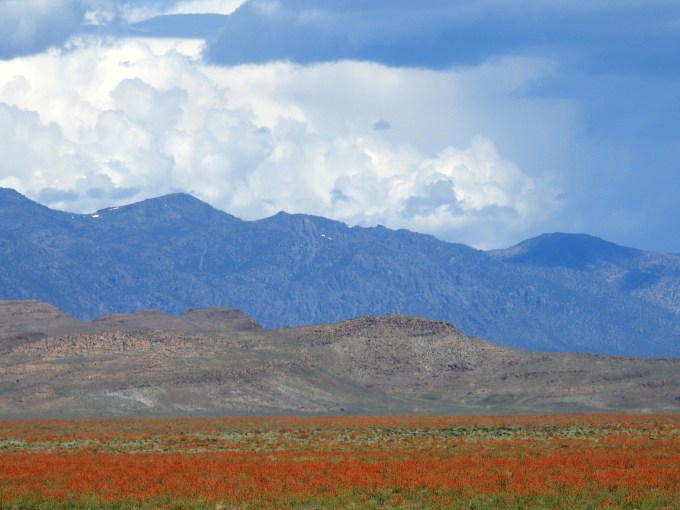
Yet another long, but scenic, drive brought us to remote central Nevada, on Rte. 6, about 100 miles east of Tonopah and 75 miles west of Ely, the nearest towns. We had been seeing excellent wildflower displays for the last few weeks, resulting from unusually high winter precipitation, but the sagebrush flats along Rte. 6, turned orange by a native mallow, Sphaeralcea parvifolia, were the most impressive yet. Our objective in this area was to locate the dullest target of the year, Micromonolepis, an annual herb with nearly unnoticeable flowers. This Great Basin endemic frustrated us several times in California, where it is rare. We looked for it near an interesting travertine formation from a spring that no longer flows, but again, no joy. It was a lovely camping site, though.
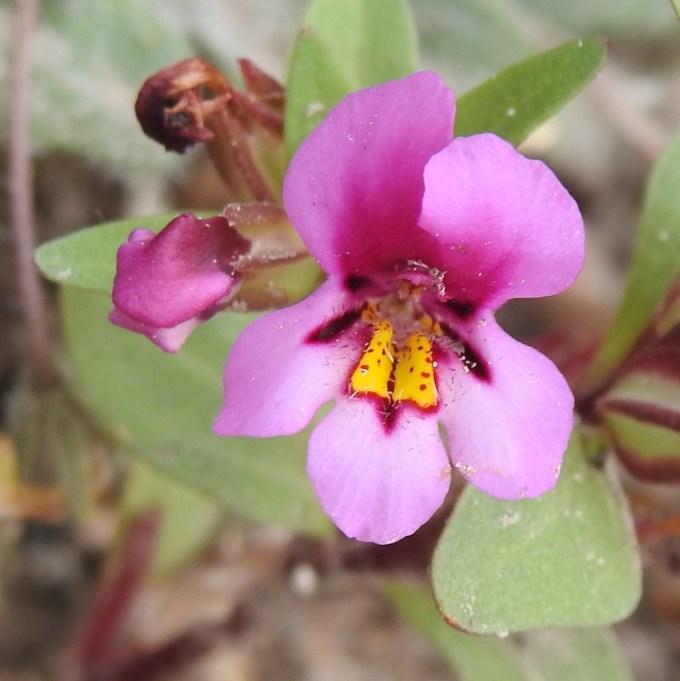
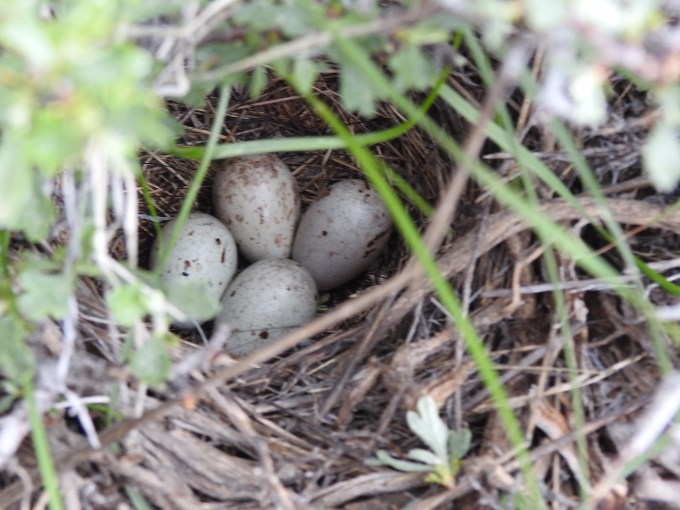
Our last six targets were located in a relatively small region north of Mono Lake (Mineral and Lyon Counties, NV and Mono and El Dorado Counties, CA), so our long drives were over for the time being. Southeast of Mina, NV we found Oryctes, in the potato family, another genus we sought unsuccessfully on the edge of its range when we lived in California. We only found three individual plants and felt lucky to have seen it at all. Our efforts to detect a tiny phlox family member, Lathrocasis, near the ghost town of Bodie, CA, were partly foiled by road closures due to flooding, and made more dramatic by looming thunderstorms, which eventually turned the ground white with a thick coating of sleet. But as compensation, I flushed a Vesper Sparrow off its nest; it ran along the ground with wings raised in a distraction display to draw us away from the nest, which contained four eggs.
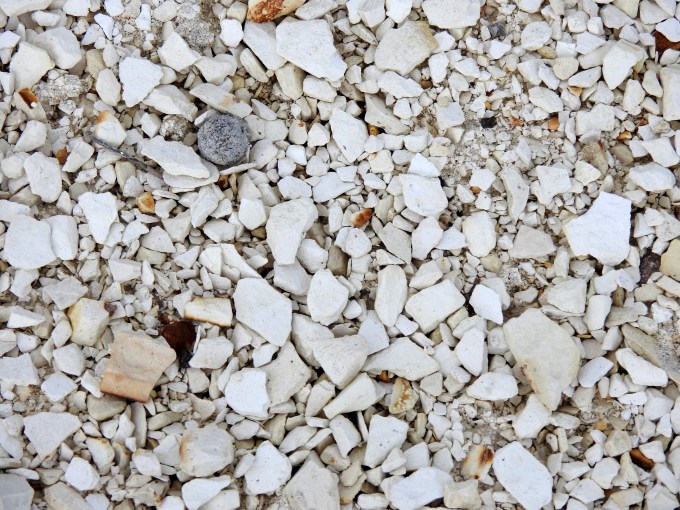
Returning to Nevada, we headed towards coordinates for Sonnea, a cute popcorn-flower. I wondered if/how the area would differ from the sea of sagebrush through which we had been traveling for days. As we approached I saw a white hill in the distance — could this be it? Yes! Nothing quickens the pulse like a potentially “new” habitat and many of the most interesting habitats result from unusual bedrock or soil. We stepped out of the truck and I just knew this would be good! As I quickly ascended the hill (we were yet again threatened by a storm), the suspense built … and the answer was … pumice! The white color was caused by extremely fine-textured volcanic projectiles, made lighter than water by virtue of entrapped air bubbles. I recognized all the genera present (including the target Sonnea), but many species seemed unfamiliar. In the end, in an area less than 100 yards on a side, we found eight new species! This is one of the main reasons we do these searches — they sometimes take us to truly magical places.
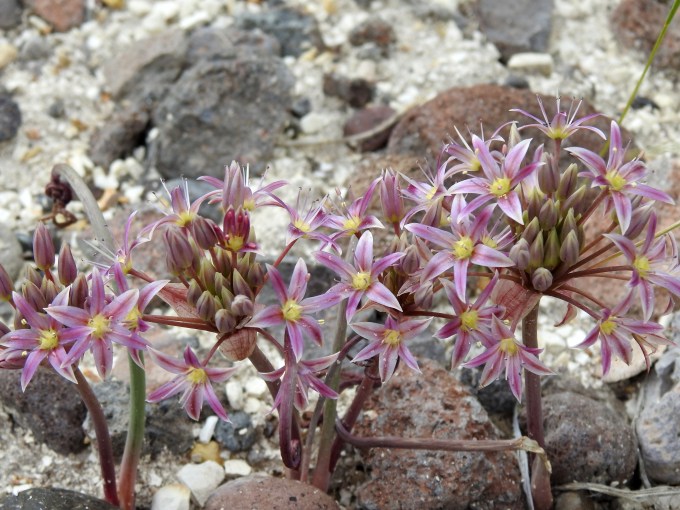
Two more successes followed. We first located Blepharidachne east of Yerington, NV; this is an annual grass of the Great Basin. Then we found Tripterocalyx crux-maltae, looking much like a sand verbena, in the northeast Carson Valley, NV; I think this is the only target genus this year we have spotted from the truck, before even stopping! Both of these genera were past nemeses and it felt great to finally track them down. Finally, we located the mustard Yosemitea near Luther Pass, south of Lake Tahoe, but only basal leaves were present (despite the species usually being in fruit by this date) and we could not identify it conclusively. But we may be able to try again in five weeks when we pass near the area again.

Our field work done for the moment, we visited our friend Mike in Napa, and then set up our camper in the Bay Area, at the home of our friends Tam, Rob, and Sierra. We’ll spend a week here preparing for a birding tour to Borneo.
 Nomadic Naturalists