From Sept. 9 – 26 we traveled to central Amazonia with Field Guides, Inc. The trip, led by the remarkable team of Bret Whitney and Marcelo Barreiros, was based from Manaus, located close to the most biogeographically important crossroads in the entire Amazon: the confluence of the Amazon River and its largest tributary, the Rio Negro.

The Amazon River was formed as the east slope of the uplifting Andes created a massive watershed. Between the Andes and the Atlantic Ocean lay two large formations, the Guiana Shield to the north and the Central Brazil Shield to the south. The primary channel for drainage of the region formed in the weaker rift between the two shields and became the Amazon River. Because the Andes contained rich, mineralized soil, the Amazon and its tributaries that arise in the mountains carry an immense sediment load, which imparts a pale, muddy appearance to their waters. Consequently, they are called whitewater rivers (a much different usage of the term than to describe rivers with raging rapids).

In contrast, rivers originating in the shields, which erode to produce quartz sand, have very low sediment loads, and so have transparent, though sometimes colored, waters. Those flowing from the Guiana Shield, such as the Rio Negro, have considerable tannin content leached from foliage, so they are tea-colored, and are classified as blackwater rivers. Rivers with headwaters in the Central Brazil Shield often are nearly colorless and are known as clearwater rivers.

The Amazon River is the largest in the world in terms of the volume of water per second it discharges into the ocean at its mouth. Its average discharge approximately equals that of the seven next largest rivers combined. The Rio Negro, its largest tributary, has twice the discharge of the Mississippi River. At the confluence of the Rio Negro and Amazon Rivers, the waters mix together slowly because of different temperatures (and thus densities), velocities, and sediment loads. The waters are easily distinguished by their surface color for several miles.
The level of the Amazon River varies by 30 feet or more during the year; the area of inundation by the river increases by about three times between the dry and wet seasons. Because rainfall in the Andes is affected by different factors than in the lowlands, whitewater rivers have an annual low-water to high-water cycle that differs in timing from that of rivers originating in the shields (which themselves vary somewhat). The Rio Negro was falling rapidly (about a foot per day) preceding our trip, and we could not reach by boat some areas easily accessible just a week or two before.
In the vicinity of Manaus, near the confluence, the Amazon runs approximately west to east, and the Rio Negro flows roughly northwest to southeast, so where they join they define three unequal pie wedges of land, called interfluves. It is not surprising that these wide rivers form major barriers to dispersal, and a number of mammals are found in only one of the interfluves, sometimes with sister species evolved from a common ancestor present across one or both rivers. For example, on the two banks of the Rio Negro are two different species each of night monkeys, red howlers, and three-toed sloths. What is surprising to me is that about 30% of the bird species in each interfluve do not occur in the adjacent regions; the rivers are so wide that they even create a barrier to population expansion of many flying birds!

During the first half of this birding tour, we covered land areas on both sides of the Rio Negro, north of the Amazon River. In the second half we were based on a live-aboard boat, allowing us to explore silty Marchantaria Island in the Amazon River; remote Jau National Park; and the spectacular Anavilhanas Archipelago, consisting of almost 400 islands within the Rio Negro. This itinerary gave us access to a number of distinct forest habitats, each with characteristic birds. We sampled both terra firme (land that is permanently above water) and flooded forest (which is annually inundated by rising river waters). Most terra firme has soil that is fairly rich, and exhibits significant topography, but we also visited an area of campinarana, which was quite flat, with sandy soil.
Flooded forests are particularly fascinating; everything must take to the trees when they are inundated. We explored several types of flooded forests, hiking around after reaching them by boat. Igapo occurs along blackwater rivers, in sandy soil, whereas varzea occurs along whitewater rivers, with richer silty soil (both terms are sometimes used in a more general sense, to refer to any Amazonian flooded forest). Chavascal is a type of igapo with short trees forming a uniform canopy composed of only a few species, and little to no understory; it is less diverse than typical igapo but supports a distinct bird community.

In total we personally observed about 297 species of birds and 16 species of mammals. I got 61 life birds and 10 new mammals; Eileen added 69 birds and 9 mammals. We may add another life mammal when we get back to El Paso and can do some research on a mouse we found with a thermal imager and saw and photographed well. Some favorite mammals were Pied Tamarin, a stunning small monkey; Guianan Squirrel Monkey, another cute primate; Amazon River Dolphin, a large, pink to red, bottle-nosed species we fed by hand; and Tucuxi, a small, gray dolphin with a dorsal fin.

There are far too many bird favorites to list them all, but here is a selection of top candidates, in no particular order:
- Guianan Red-Cotinga, a stunning burgundy-colored frugivore (fruit-eater);
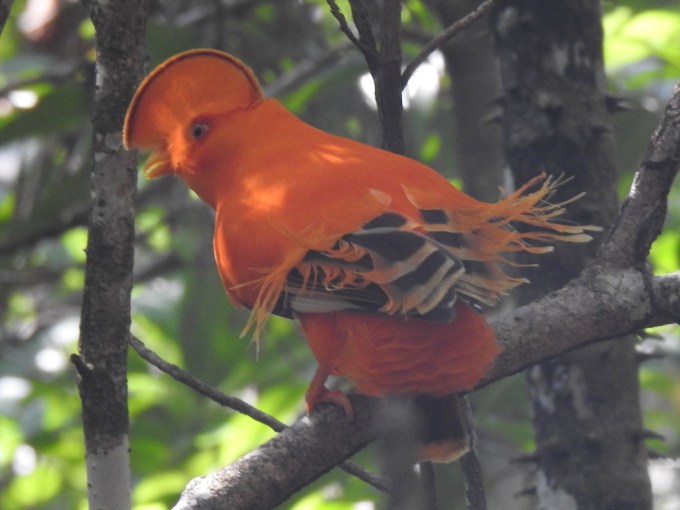
- Guianan Cock-of-the-Rock, the bright orange males attending communal display grounds (leks) to attract mates;
- Harpy Eagle, seen at a nest, this massive predator taking sloths and monkeys in the canopy;
- Crested Owl, an infrequently seen species with long, white “ear tufts”;
- Yellow-browed Tody-Flycatcher, a pair seen constructing their nest right next to an active wasp nest for protection from predators;
- Wire-tailed Manakin, a striking yellow, red, and black lekking species;
- Chestnut-headed Nunlet, a very rare puffbird about which little is known;
- Black-bellied Cuckoo, a large rusty bird with a long, black and white tail;
- Slaty-capped Shrike-Vireo, a high canopy songbird with a striking yellow and gray head pattern;
- Spotted Tanager, lime green and turquoise with dense black polka dots;
- Gilded Barbet, a black, yellow, and apricot member of a vocal group related to toucans;
- Rufous Potoo, a nocturnal insectivore distantly related to our whip-poor-wills;
- Green-tailed Jacamar, with intense bluish green iridescent plumage;
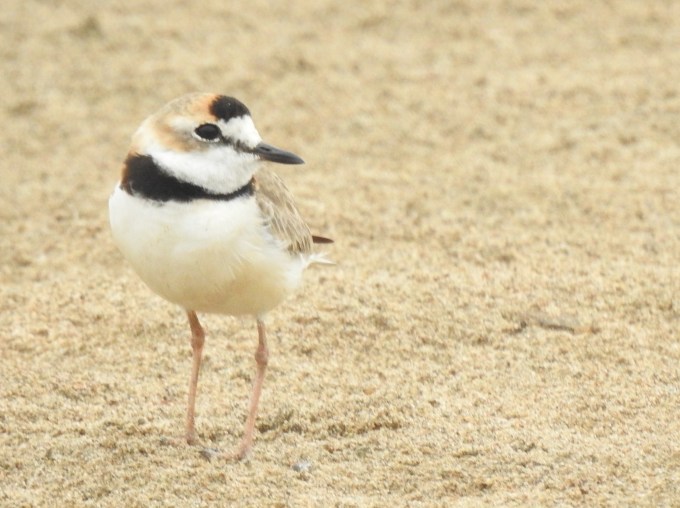
- Collared Puffbird, rufous with a unique black band completely encircling its neck; and
- Crimson Topaz, a large and gorgeous hummingbird.

Overall, this trip provided a remarkable sampling of habitats and fauna at the biogeographical center of Amazonia, the most diverse ecosystem on earth!

 Nomadic Naturalists
One of our favorite Brett trips!! And sounds like you also had a remarkable journey. How is Brett?? Does he still spend most of his time in Brazil?? Married?? Did you see the Opera House?? Where are you off to next? Connee and Bob ________________________________
LikeLike
Sounds like a great trip with so many new species of birds and mammals, not much mention of flowers seen which must have been many. Adirondack fall colors are great in this area. Stay safe, Gary
Sent from Mailhttps://go.microsoft.com/fwlink/?LinkId=550986 for Windows
LikeLike