We spent the three-week period from June 17 to July 8 traveling to, in, and back from Sabah, Malaysia, on the northeast portion of Borneo. This is the third largest island in the world, after Greenland and New Guinea. It has the most diverse forests outside Amazonia, and in addition to being a fine birding destination, is one of the very best mammal-watching places on the planet.
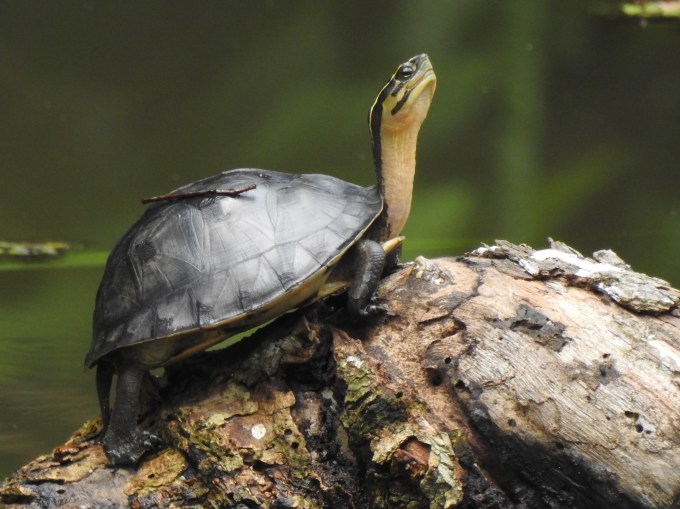
We signed up for this birding tour with our friends Terry and Rhys four years ago, but the trip was delayed by COVID. The trip was led by Megan Crewe of Field Guides, Inc., and there were eight participants. It took about 51 hours door to door, including an overnight layover in Kuala Lumpur, to reach our starting point in Sandakan, but merely 35 hours to get back.
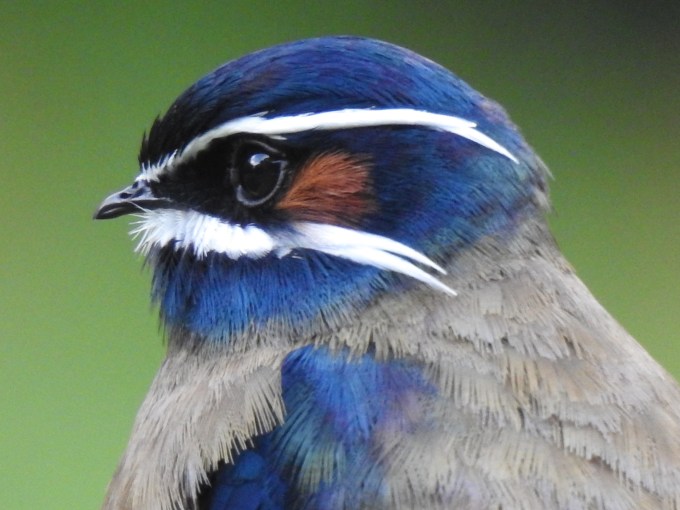
The people in Sabah were almost uniformly polite and sincere, making it a very welcoming country. Accommodations were quite satisfactory and the food was reasonable, though it was dominated by Chinese cuisine, so the variety seemed a bit limited. Traffic and road conditions were about average for this type of trip, in our experience.

Birding tours are run to Borneo in both winter and summer. The summer trips normally experience less rain and encounter fewer leeches, but find fewer species, due to the absence of wintering birds from East Asia. As we had seen most of these extra species in our one other trip to the region (Thailand in 2013), we elected to visit in summer, but the strategy was not very successful, because we ended up having weather pretty typical of the rainy season anyway.

Sabah has two major biomes, lowlands and highlands, the latter starting around 4000 feet of elevation; we got as high as 6300 feet. Although some species occur in both lowlands and highlands, the majority are restricted to one biome or the other, which often aids in species identification. The lowland forests have high canopies with some emergent trees and are dominated by dipterocarps, a tropical family named for their winged fruit. The highland forests contain a variety of trees in the oak family, the acorns of which support the most diverse assemblage of squirrels in the world.
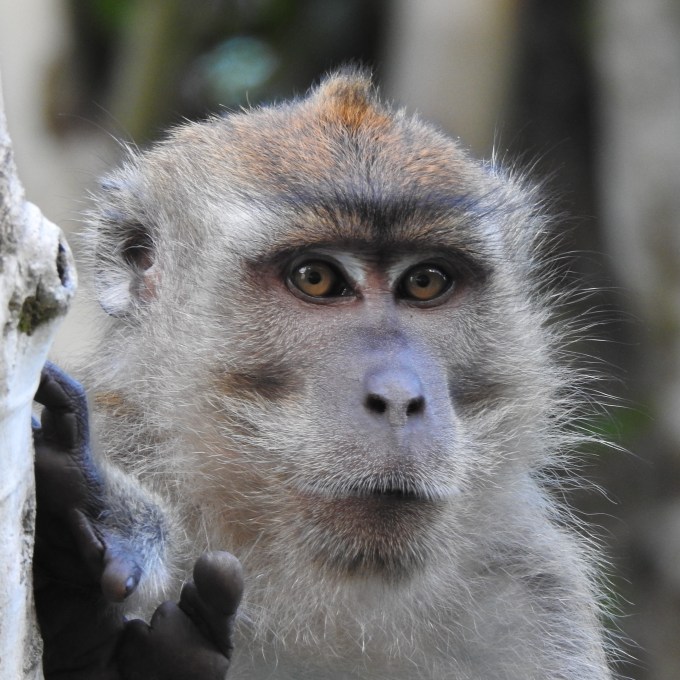
The vast majority of our time was spent close to one of four base locations: the Rainforest Discovery Center at Sepilok, with an excellent canopy walkway; the Borneo Rainforest Lodge in Danum Valley, with true forest primeval; the Sukau Rainforest Lodge on the Kinabatangan River; and on the slopes of Mount Kinabalu, our only access to highland habitat. We spent an average of 3.5 nights per lodge or hotel, an unusually high number, which was nice as it meant less frequent repacking.
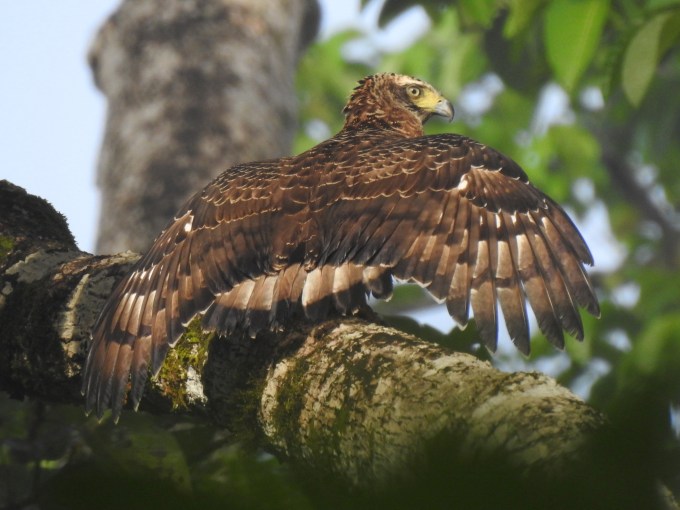
Some of our favorite species and encounters are listed below, organized by location. At Sepilok, from the tallest canopy tower at dawn, I spotted a large, warm, dome-shaped feature in the thermal imager. In the telescope this was revealed to be a mother Orangutan on her nest, which soon proved to hold an infant as well!! It was a thrilling way to see our first non-human hominid. Another favorite experience was seeing a large flock containing three species of Green-Pigeons in fruiting trees.

In Danum Valley, we were extraordinarily lucky to see the remarkable Argus Pheasant twice. The first encounter was with a male on its display grounds. They rarely allow close approach, but we got within 25 feet of this bird and then spent perhaps half an hour in its presence. Although it did not display, it startled us by giving its exceptionally loud call multiple times. Other highlights were elegant Whiskered Treeswifts; an exquisite Blue-headed Pitta; exotic Rhinoceros Hornbills; Eastern Gray Gibbons, easy to hear but hard to see; and about five strikingly patterned Malay Civets.
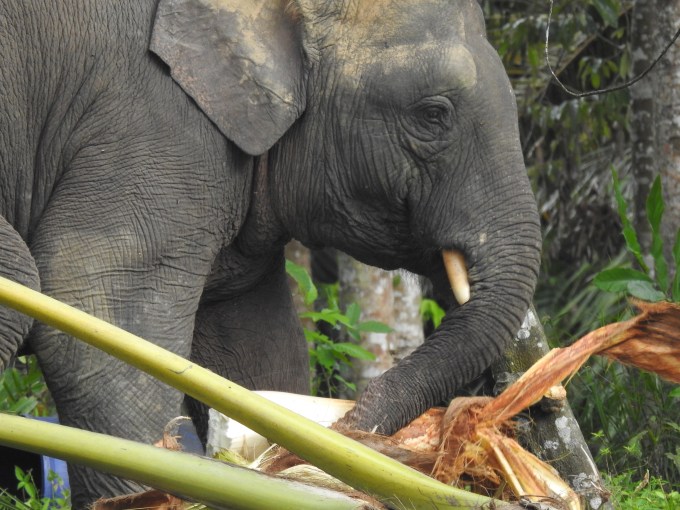
Most of our time at Sukau was spent in boats, exploring the Kinabatangan River and several of its tributaries. This is an idyllic way to bird and is often especially good for photography. Favorites here were Proboscis Monkey, Saltwater Crocodile, Storm’s Stork, Large Frogmouth, Hooded Pitta, Gray-headed Fish Eagle, and Straw-headed Bulbul. The population of the latter has been decimated by locals trapping them because their gorgeous song makes then prized cage-birds. We were lucky to observe a single Asian Elephant along the main river; the animals in Borneo are somewhat smaller than those found on the mainland.
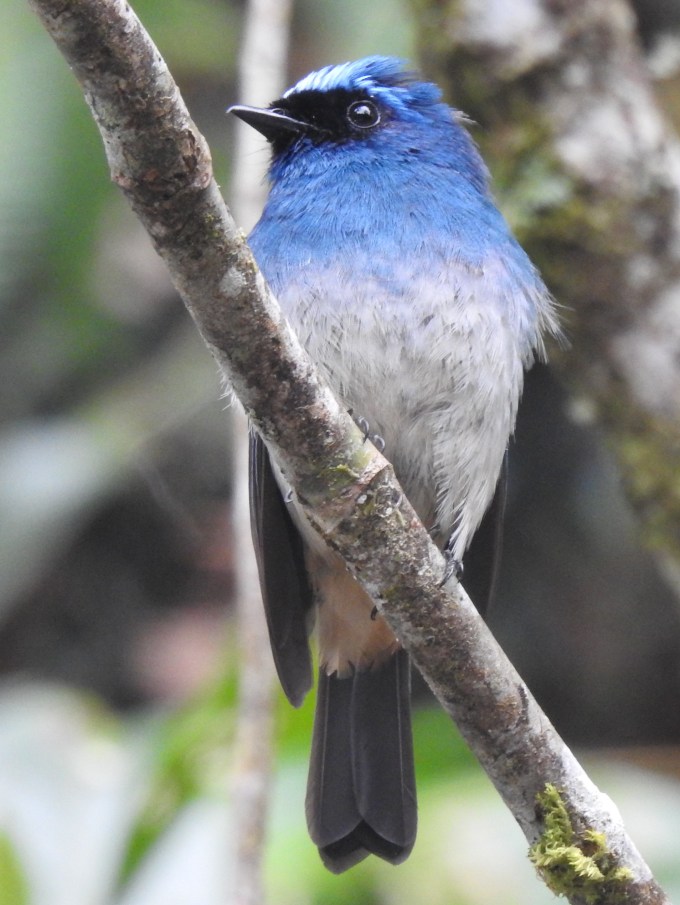
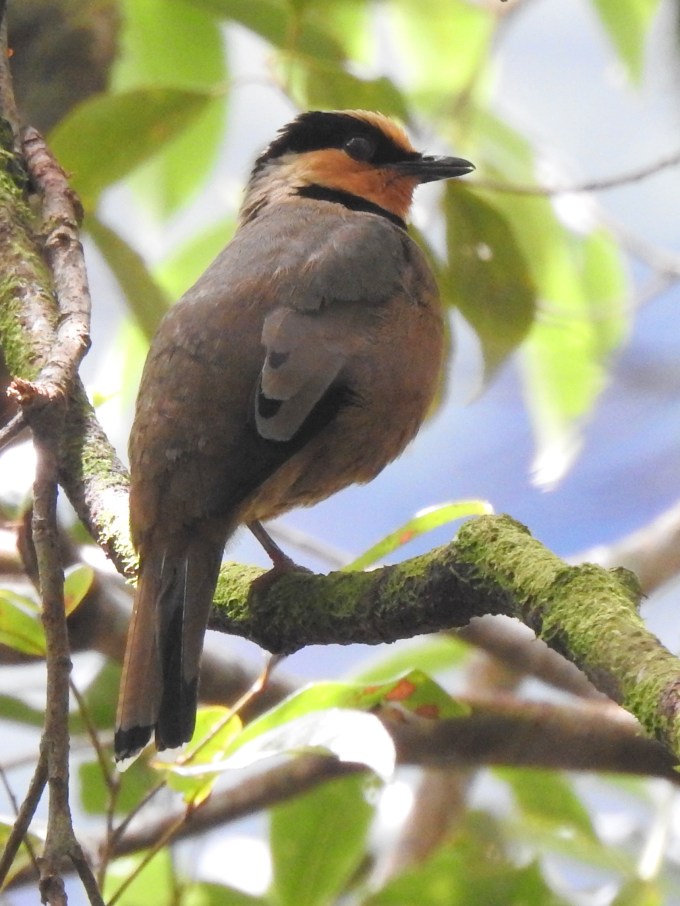
Finally, in Kinabalu Park, highlights included the luminous emerald-colored Whitehead’s Broadbill; the lime and maroon Bornean Green Magpie; the elegant Fruit-hunter, a thrush; magnificent Wreathed Hornbills; and Whitehead’s Trogon, an ethereal combination of scarlet, apricot, gray, and rust. We saw no less than five species of squirrels here, including the adorable Tufted Pygmy Squirrel, which is only 6 inches long, half of that being its tail!
We had one very scary event during a night drive at the Borneo Rainforest Lodge. After coming to a stop on a hill, our open golf cart-like vehicle rolled down the slope backwards, out of control, crashing into a ditch at considerable velocity. I was standing in the rear at the guide’s station using the thermal imager at the time and hit the deck but smashed my back on a metal support, which at least kept me in the vehicle. That night when I had to go to the bathroom, it took 30 agonizing minutes to get out of bed, hobble across the room, and get back in bed. I endured a lot of pain over the next week. Eileen was not injured but it was a very traumatic experience.
Our final statistics were as follows. We identified 220 species of birds and 25 species of mammals during the trip. Of these, Eileen saw 106 new birds and 20 new mammals, while I had 111 and 21, respectively. At higher taxonomic levels, we saw four new families: Hominidae (Orangutan); Lorisidae (Malaysian Slow Loris); Tarsiidae (Western Tarsier, my 500th mammal species); and Tupaiidae (Slender Treeshrew, also a new order). Eileen saw her 4000th bird species, Gray-hooded Babbler, in the Borneo Rainforest Lodge on June 26. In addition we saw 53 new species in other groups, including 13 butterflies and 13 reptiles and amphibians.

 Nomadic Naturalists
Sorry about the golf cart crash but congrats on the tarsier which I still need after 4 trips to Borneo. Was it at Sepilok?
LikeLike
Neat Brian, Hope the back recovered, luckily you didnt get thrown out of the vehicle. Had a great trip west. Areas to the north and south of us in Hamilton county have been shut down with flooding of the major highways, Long lake and speculator no roads in or out as bridges were washed out. The dam on Jennings Pond in back of the hotel in Long Lake was completely washed out, which closed the big bridge across the lake going north. Safe travels, Gary t Sent from Mailhttps://go.microsoft.com/fwlink/?LinkId=550986 for Windows
LikeLike
Sounds like a great trip – but certainly didn’t need to slide down a slippery slope! Do hope you are fully recovered and enjoying the post-trip journey. Bob and Connee ________________________________
LikeLike